


Table of Contents
Table of Contents
The Three Second Degree Reiki Symbols
The three Reiki symbols taught at Second Degree are Cho Ku Rei, Sei He Ki and Hon Sha Ze Sho Nen. Cho Ku Rei connects you with earth ki, the energy of the body and physical reality. Sei He Ki connects you with heavenly ki, a higher-frequency energy that operates at the level of mind and emotion. Hon Sha Ze Sho Nen is different from the other two: it doesn’t bring in an energy. It brings about a state of oneness, which makes distance healing possible.
I’m Tina Shaw. I’ve practised Reiki since 2001 and taught it for 25 years. This guide covers what each symbol means and what it’s used for. I’m leaving out how to draw them on purpose. You learn that properly on the course, and there’s more to working with a symbol than the shape on the page.
Reiki symbols at a glance
| Symbol | Represents | Frequency | Often called on for |
|---|---|---|---|
| Cho Ku Rei (CKR) | Earth ki | Lower | The physical, grounding, space clearing |
| Sei He Ki (SHK) | Heavenly ki | Higher | The mental and emotional, study, empathic shielding |
| Hon Sha Ze Sho Nen (HSZSN) | Oneness | A state, not an energy | Distance healing, deep connection in treatment |
Where did the Reiki symbols come from?
The symbols weren’t invented by Mikao Usui. They were existing Japanese symbols that Usui and his senior student, Toshihiro Eguchi, brought into the system. Most of Usui’s students never used them. Second Degree students spent months, often six to nine for each energy, getting to know earth ki and heavenly ki through meditation and chanting.
The symbols came in later as a more direct route to those same energies, mainly for students with less time, including Imperial Officers such as Dr Chujiro Hayashi. Through Hayashi, and then Mrs Takata, the symbols reached the West. That’s why most Western Reiki courses now put them at the centre of Second Degree.
Cho Ku Rei: the earth ki symbol
Cho Ku Rei represents earth ki, the energy of physical reality: the body, the earth and our physical existence. It resonates at a lower frequency than Sei He Ki. Lower doesn’t mean lesser. Grounding frequencies are as essential to life as higher ones.
When I talk about this, I often think of a walk through a forest. The trees with deep roots are the ones that survive the storm, and the trees with shallow roots get knocked down. People are the same. The deeper our roots, the better we cope with the storms that sometimes rage through our lives. That depth is what earth ki supports.
People often call CKR “the power symbol” because it can feel strong and immediate. That doesn’t make it more powerful than SHK. The energies are different, not ranked.
Students usually describe CKR as heavy, dense and solid. Some say it feels slow and thick like treacle; others say it’s enveloping and warm. Because it resonates with the body you’re feeling it through, most people notice it first.
What it’s used for:
- Grounding and supporting the physical body
- Space clearing, to shift heavy or stagnant energy from a room or home
- Strengthening your own energy field (a strong, clear field is the best protection there is)
- Everyday uses, from blessing food to a Reiki bath. You’ll find more in 13 Creative Ways to Use Reiki Symbols
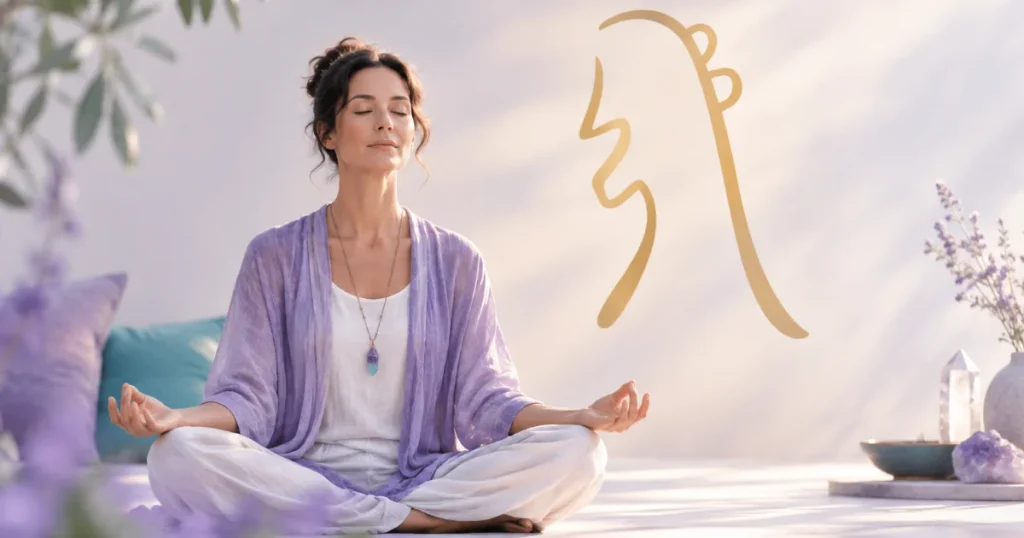
Sei He Ki: the heavenly ki symbol
Sei He Ki represents heavenly ki. It resonates at a higher frequency than Cho Ku Rei and works at the level of mind and emotion. The version used in Reiki comes from a Japanese symbol that itself derives from a letter of the Sanskrit alphabet. When that sound is chanted, it’s said to produce something like mental spring cleaning, which gives you a feel for its quality.
SHK is very powerful, but the sensations it produces are often more subtle than CKR’s. Students describe it as light, fine or wispy, sometimes shimmery or like gentle waves. Many find it takes a little longer to recognise in their hands. That says more about how we notice energy than about how strong it is.
What it’s used for:
- Supporting mental and emotional balance
- Shielding from unwanted empathic experiences, so you aren’t absorbing what other people are feeling
- Supporting study and learning
- Helping an affirmation or intention take root
Hon Sha Ze Sho Nen: the distance symbol
Hon Sha Ze Sho Nen is the symbol of oneness. It doesn’t produce an energy. It brings about a state in which the usual limits of time and space become permeable. It’s made of five Japanese kanji layered into one character, so no single translation captures it. In Shinto tradition, the phrase is associated with “man and God are one”; Hiroshi Doi gives it as “I unite with God.” What every interpretation shares is a quality of connection across apparent separation.
It’s best known as the distance healing symbol, but you don’t strictly need it for that. You can send Reiki at a distance from the First Degree onward. HSZSN gives you a more focused, reliable way into the state of oneness that makes distance healing natural.
What it’s used for:
- Distance healing for people, animals, situations and the wider world
- Sending healing to the past (to the effect an event still has on you now) or ahead to a situation that’s coming
- Inner child healing
- Deepening the connection between you and the person you’re treating
A story about distance healing
When I was newly qualified, my website had a free distance healing request page. People sent me their name and location; I added them to a distance healing book and sent to the list each evening.
One evening I got a phone call from someone who described themselves as a medical scientist. They’d found my site by accident, were appalled by it, and were determined to prove I was running a con. So they’d submitted their own name as a test, sat down at the agreed time, and done everything they could to feel nothing.
They felt it anyway, strongly enough that they couldn’t explain it away. They rang to apologise and to book a session. Later they trained with me to Second Degree and brought several friends with them. They had no expectation, no openness and no wish to believe, and the energy still reached them.
Do I need to be attuned to a symbol for it to work?
No. That belief comes from Western attunements, where symbols are placed into the student as part of the ritual. Usui’s original empowerment, Reiju, makes the same connection without using symbols at all. What matters is that you’re connected to Reiki. Once you are, a symbol will direct the energy in its own particular way. That connection starts at First Degree.
Follow the energy, not the logic
Some areas naturally tend to draw one energy or the other. A physical injury may call for CKR, and stress held in the head or heart may call for SHK. But either frequency may want to flow to any part of the body.
Sometimes a client comes to me with a physical problem. I might expect CKR to be needed and find that SHK wants to flow instead. That’s because physical conditions can be linked to emotional trauma, or can cause it. Reiki knows better than we do what a person needs for their energy to shift into the best state for healing.
So it matters to get out of your ego and into the flow of the energy. Rather than pushing what you think a person needs, you notice which energy is already flowing, then support and enhance it with the matching symbol, whether or not that makes logical sense to you.
You can only do that if you can recognise each energy when it turns up, which is the next point.
Knowing what a symbol does isn’t the same as knowing the symbol
Many schools teach you how to draw the symbols and what they’re for, then send you off to use them in treatments, often layered one on top of another. What they leave out is time with each energy on its own. Without that, a symbol stays a technique. You know what it’s supposed to do, but you couldn’t recognise its frequency if it turned up in your hands.
On my courses, the symbols come first as a meditation practice. The symbol meditations do two things.
First, you get to know each energy. You spend time with earth ki and then heavenly ki, noticing how each feels in your body and how it affects your thoughts and emotions. Over time, that recognition becomes your reference point for working with yourself and others.
Second, they’re an extension of your self-healing. Meditating with CKR and SHK brings the physical, mental and emotional parts of you into balance.
Without that relationship, the symbols stay abstract. With it, they become a language you actually speak. If you are interested in diving deeper into Reiki as a spiritual practice, this book is a great read: Inner Heart of Reiki by Frans Stiene.
No pressure to learn the symbols on the day
On many courses, you’re shown the symbols in the morning and expected to draw them from memory by the afternoon, in a room full of people.
I do it differently. You learn the symbols at home, in your own time and at your own pace, before the first live module. The pre-course study takes around six hours, done in short sessions of 25 to 30 minutes. There’s no pressure, no comparison and no one watching. When we meet, the drawing is already done, and we can spend our time on what matters: using the symbols and getting to know their energies.
Groups are small, no more than four students, so you’ll never be lost in a crowded classroom. Support continues after the course too, including a Reiju empowerment sent every Sunday.
Ready for Second Degree?
If you already hold First Degree, from me or another teacher, my Second Degree Reiki course is where you’ll learn these three symbols and build a working relationship with each one. You can take it over two consecutive Saturday mornings or as a single intensive day.
New to Reiki? The symbols build on a foundation, and that foundation is First Degree: learning to work with Reiki for yourself and others, with self-healing at its heart. Start with First Degree Reiki and the symbols will be waiting for you when you’re ready.
Frequently asked questions
What are the three Reiki symbols?
The three Second Degree Reiki symbols are Cho Ku Rei (earth ki), Sei He Ki (heavenly ki) and Hon Sha Ze Sho Nen (oneness). They’re used to bring specific qualities of energy into treatment and to send distance healing.
What does Cho Ku Rei mean?
Cho Ku Rei represents earth ki, the lower, grounding frequency of the body and physical reality. It’s often called the power symbol and is commonly used for physical issues, grounding and space clearing.
What is Sei He Ki used for?
Sei He Ki represents heavenly ki, a higher frequency that works at the level of mind and emotion. It’s used to support emotional balance, study and learning, and to shield against unwanted empathic experiences.
Why might SHK flow when someone has a physical problem?
Physical conditions can be linked to emotional trauma or can cause it. So even when the problem looks physical, the energy that flows may be SHK. Reiki knows what a person needs, and the practitioner’s job is to notice which energy is flowing and support it.
What is the Reiki distance symbol?
Hon Sha Ze Sho Nen is the distance symbol. Rather than producing an energy, it brings about a state of oneness in which physical distance is no barrier.
Do you need Reiki training to use the symbols?
The symbols direct Reiki, so you need to be connected to Reiki first. That connection begins at First Degree, and the three symbols are taught at Second Degree.
Can I take Second Degree if I did First Degree elsewhere?
Yes. My Second Degree course works for students whose First Degree was with another teacher.

0 Comments